

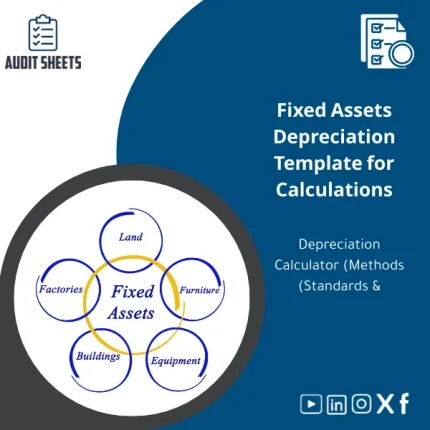
Fixed Assets Depreciation Template for Calculations
Original price was: 179.00 $.139.00 $Current price is: 139.00 $.
A professional Fixed Assets Depreciation Template that calculates depreciation using multiple accepted methods and supports ISA & SOCPA-compliant audit files. Save time, reduce calculation errors, and produce audit-ready fixed asset schedules and supporting worksheets.
Key benefits & value for audit and accounting teams
The Fixed Assets Depreciation Template translates technical depreciation rules into a disciplined, repeatable workflow suitable for audit files. It reduces manual calculation time, enforces consistent presentation and builds the audit trail that reviewers expect under ISA and SOCPA.
How the features convert to practical value
- Multi-method support (straight-line, declining balance, sum-of-years-digits, units-of-production): apply the required method per asset class and compare variances quickly in audit schedules.
- Reconciliation & movement schedules: month/quarter/year reconciliations to link opening balances, additions, disposals, transfers and closing balances — essential for substantive testing.
- Documented management estimates: dedicated fields for estimated useful lives, residual values and impairment triggers to support auditor inquiries and workpapers.
- Exportable reports: printable schedules and CSV exports for working papers or import to engagement software.
Use cases & real-life scenarios
Below are typical scenarios where the template delivers immediate ROI.
Monthly close and audit support
During monthly close, accountants use the template to update additions and disposals, generate depreciation expense and reconcile to the general ledger. At year-end audit, auditors attach the schedule and the movement worksheet as primary evidence.
ISA & SOCPA compliance testing
Use the template to document judgemental areas (useful lives, impairment indicators) and to prepare samples for substantive testing in accordance with ISA. The structure maps to expected audit file sections.
Client review and advisory
Firms offering advisory can run “what-if” scenarios (changing useful life, residual values or method) to demonstrate financial statement impacts and advise management on policy choices consistent with local applications of international standards.
Who is this product for?
The template is built for:
- Audit and accounting firms preparing ISA-compliant audit files.
- Legal auditors and statutory auditors working under SOCPA frameworks.
- Internal audit teams and finance departments needing consistent fixed asset schedules.
- Senior accountants who prepare management accounts and year-end disclosures.
How to choose the right variant
Although the core file is the same, select based on:
- Complexity of asset register: Small portfolios (under 500 items) — standard template; large portfolios or componentised assets — choose the extended template with batch processing and grouping.
- Integration needs: If you need CSV exports to upload to ERP, confirm the CSV mapping settings; bespoke integration service is available if required.
- Standards focus: Default version includes ISA & SOCPA guidance notes; request an additional Arabic-language guide if your engagement files require bilingual documentation.
Quick comparison with typical alternatives
Many teams rely on manual spreadsheets or ERP screenshots. Compared to that:
- Manual spreadsheets: higher error risk, inconsistent layouts and no audit trail — our template enforces structure and protects formulas.
- ERP fixed asset modules: robust for posting but often poor for audit presentation and ‘what-if’ analysis — the template provides clear schedules and scenario models auditors need.
- Custom-built tools: expensive and slow to deploy — our template is ready to use and configurable, lowering cost and time to production.
Best practices & tips to get maximum value
- Start with a clean asset register export: import only validated fields (asset id, description, cost, acquisition date, useful life, residual value, accumulated depreciation).
- Lock inputs after verification: use the template’s protected cells to keep calculated fields secure while allowing authorised edits to estimate fields.
- Document judgements directly in the template: use the management estimates section so auditors see the rationale in the working paper.
- Run variance reports monthly: compare actual to budgeted and flag unusual depreciation movements early.
- Keep a copy per engagement: store in the audit file as supporting evidence per ISA requirements.
Common mistakes when buying or using fixed asset templates — and how to avoid them
- Buying a generic sheet: Get a template designed for auditors — ours maps to audit workpaper structure and includes evidence notes.
- Failing to protect formulas: Use cell protection to prevent accidental overwrites of calculated fields.
- Not documenting management judgement: The template includes dedicated fields — populate them to avoid rework during audit queries.
- Assuming ERP and audit schedules match: Always reconcile and store the reconciliation worksheet with the file.
Product specifications
- Product: Fixed Assets Depreciation Template (Excel)
- File format: .xlsx (compatible with Excel 2016+, Excel 365)
- Sheets included: Asset Register, Depreciation Schedule, Movement & Reconciliation, Journal Entry Generator, Management Estimates, Print-ready Reports
- Methods supported: Straight-line, Declining balance, Sum-of-years-digits, Units-of-production, Component depreciation
- Output: Printable schedules, CSV export for ledger posting
- Security: Protected formula cells with editable input areas
- Documentation: Step-by-step user guide and ISA & SOCPA mapping notes (English)
- Customisation: Optional paid services for ERP mapping, Arabic guide or bespoke calculations
Frequently asked questions
Is this template compliant with ISA and SOCPA audit documentation requirements?
Yes. The template is designed to support audit documentation under ISA and reflects common SOCPA requirements by including movement schedules, judgement documentation and clear reconciliations that auditors expect to find in the working papers.
Which depreciation methods does the file support and can I add a custom method?
The template supports straight-line, declining balance, sum-of-years-digits and units-of-production, plus component-level depreciation. You can add simple custom methods by adjusting the calculation sheet, or request a custom version if you need complex proprietary methods.
Can it integrate with our ERP or accounting system?
The template exports CSV files mapped to common ledger fields. For direct integration or bespoke file mappings, we offer a paid configuration service to match your ERP import format.
What if we need training or change requests after purchase?
We provide a concise user guide and can deliver short online training for teams as an add-on. Change requests for formula edits or additional fields are available as a customization service.
Ready to produce audit-ready depreciation schedules?
Purchase the Fixed Assets Depreciation Template and start converting your asset register into ISA & SOCPA-compliant schedules today. The template reduces calculation errors, speeds audit preparation and documents management judgements clearly.
Need bespoke adjustments or team training? Contact auditSheets for customisation and implementation assistance.




Reviews
Clear filtersThere are no reviews yet.